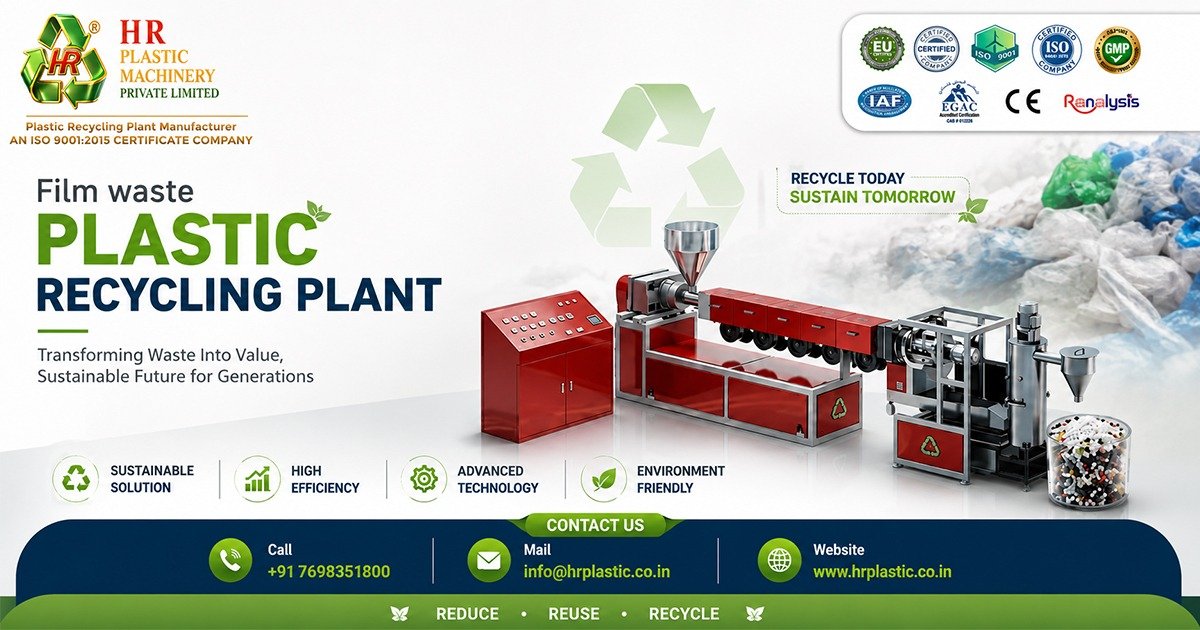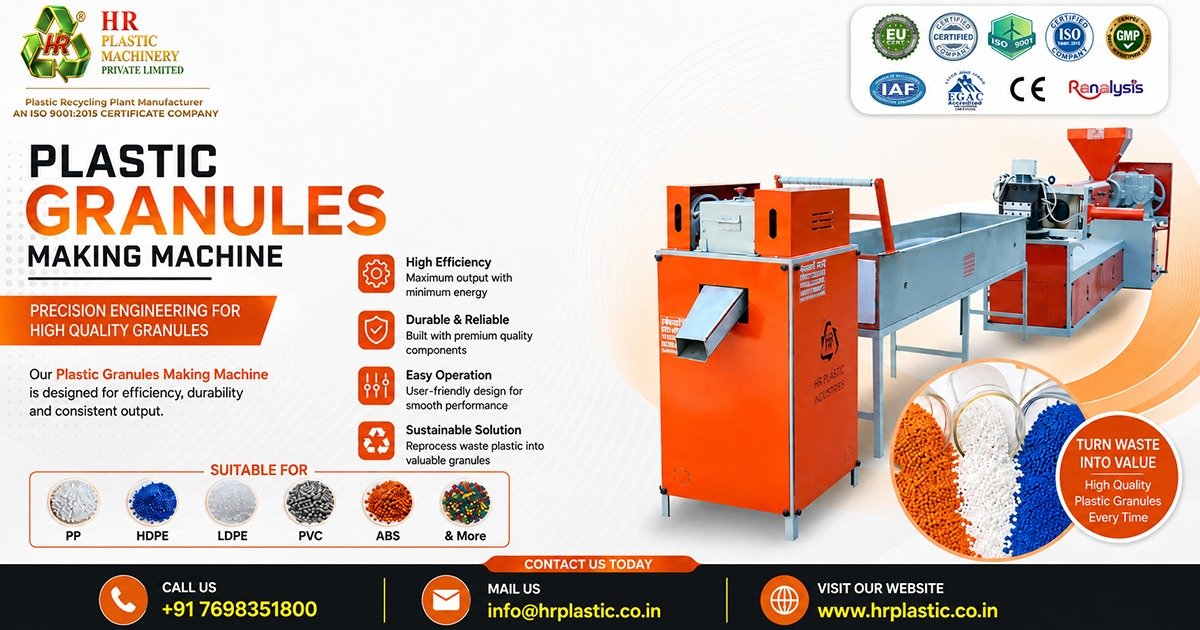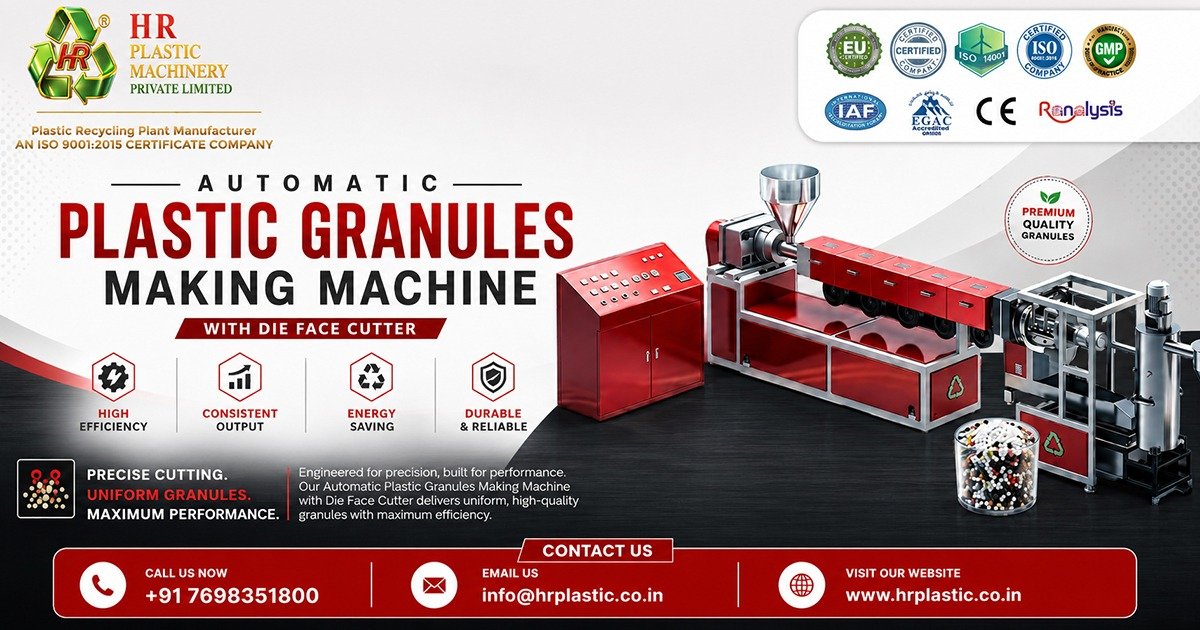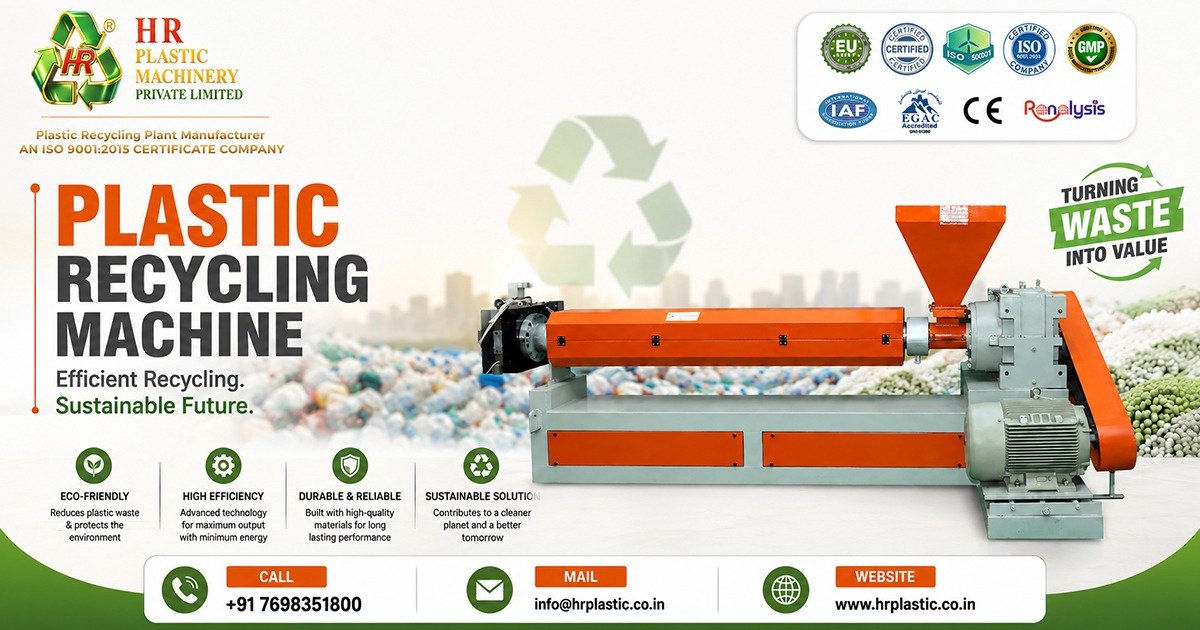
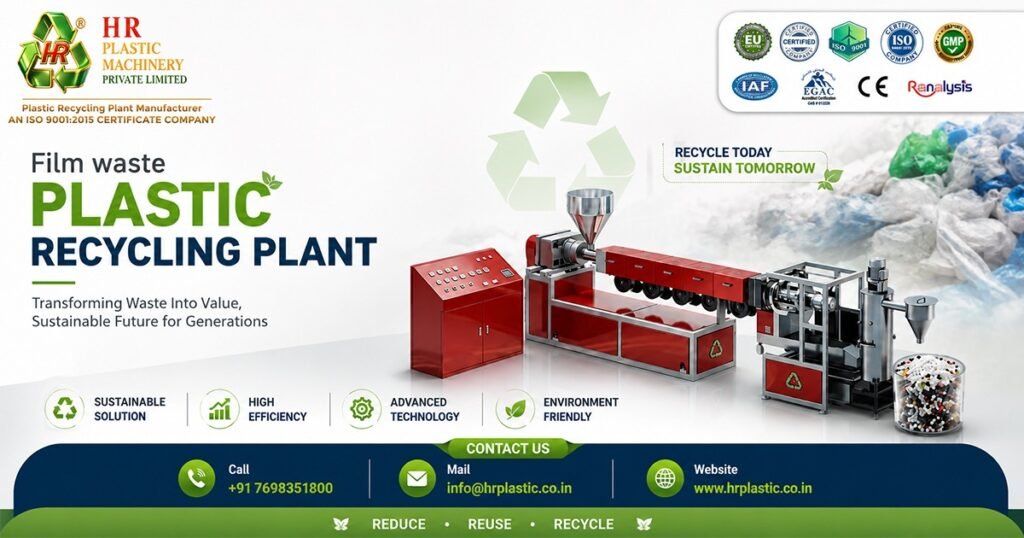
Film waste is difficult to process because it is lightweight, moist, printed, and often contaminated. A well-designed Film Waste Plastic Recycling Plant In Netherlands can convert post-industrial and post-consumer film waste into reusable plastic granules efficiently.
For reliable recycling solutions, HR Plastic Industries designs and supplies recycling machinery. Its Registered Office and Manufacturing Unit are in Ahmedabad, Gujarat, India.
Key Technical Challenges & Solutions
| Challenge | Impact on Plant | Engineering Solution |
| Low Bulk Density | Fluffy films can clog hoppers and create uneven feeding. | Force Feeders & Cutter-Compactors pre-compact and warm the film before extrusion. |
| High Moisture Retention | Trapped water can create bubbles and voids in recycled granules. | Squeezer Dryers mechanically remove excess water before extrusion. |
| Heavy Ink & Printing | Printed films can release volatile gases during melting. | Dual Vacuum Degassing helps remove volatile gases during extrusion. |
| Foreign Contamination | Sand, paper, and other contaminants can damage equipment and reduce pellet quality. | Continuous Backflush Screen Changers provide continuous melt filtration. |
Crucial Infrastructure & Utility Requirements
A commercial recycling facility needs suitable utilities and organized production areas:
- Power Supply: Industrial electricity capacity may range from approximately 150 kW to 400 kW, depending on plant capacity and configuration.
- Water Recycling System: A closed-loop water treatment system can filter and reuse process water while reducing wastewater discharge.
- Space Allocation: Dedicated areas should be provided for bale storage, sorting, washing, extrusion, pelletizing, and finished-granule storage.
- Material Handling: Conveyors, storage bins, and feeding systems should support continuous material movement.
Quality Control Matrix for Premium Granules
Quality testing helps maintain consistent recycled plastic output:
- Melt Flow Index (MFI): Measures flow characteristics and helps match granules with customer processing requirements.
- Color Sorting: Separating clear, natural, milky white, and mixed-color films can improve product consistency and value.
- Ash Content: Keeping ash content within the required specification helps reduce dirt-related processing problems.
- Moisture Testing: Low moisture is important for stable extrusion and pellet quality.
- Pellet Inspection: Size, appearance, contamination, and uniformity should be checked before dispatch.
Why Choose Us
- Complete Recycling Solutions: Machinery can be configured for different film waste types and processing capacities.
- Industrial Manufacturing Experience: HR Plastic Industries provides recycling equipment from its Ahmedabad manufacturing base.
- Customized Plant Configuration: Feeding, washing, drying, extrusion, filtration, and pelletizing systems can be selected according to requirements.
- Focus on Output Quality: Plant design emphasizes stable feeding, effective filtration, moisture reduction, and consistent granule production.
Location
The Film Waste Plastic Recycling Plant In Netherlands market covers major industrial and commercial areas including Amsterdam, Rotterdam, The Hague, Utrecht, Eindhoven, Tilburg, Groningen, Almere, Breda, Nijmegen, Apeldoorn, Haarlem, Arnhem, Amersfoort, Zaanstad, ‘s-Hertogenbosch, Zoetermeer, Zwolle, Leiden, Maastricht, Dordrecht, Ede, Leeuwarden, Delft, and Venlo.
These locations represent important manufacturing, logistics, packaging, recycling, and commercial zones where efficient plastic waste management can support circular material use.
FAQ
Q1. What film waste can a recycling plant process?
A suitable plant can process many types of plastic films, including industrial, packaging, agricultural, and post-consumer film waste, depending on the material composition and contamination level.
Q2. Why is film waste difficult to recycle?
Film is lightweight and flexible, so it can cause feeding problems. It can also retain moisture, dirt, labels, and printing ink, requiring suitable feeding, washing, drying, filtration, and degassing systems.
Q3. Can the recycling plant be customized?
Yes. Plant configuration can be selected according to film type, contamination level, required output, available space, utility conditions, and desired recycled granule quality.
Conclusion
A properly engineered Film Waste Plastic Recycling Plant In Netherlands can improve film waste recovery while producing reusable plastic granules for downstream applications. With suitable feeding, washing, drying, filtration, extrusion, and quality-control systems, businesses can build a more efficient recycling operation.
Contact HR Plastic Industries for suitable film recycling plant solutions.
Visit: www.hrplastic.co.in
Email: info@hrplastic.co.in, sales@hrplastic.co.in
Call: +91 7698351800
View Product: Click Here