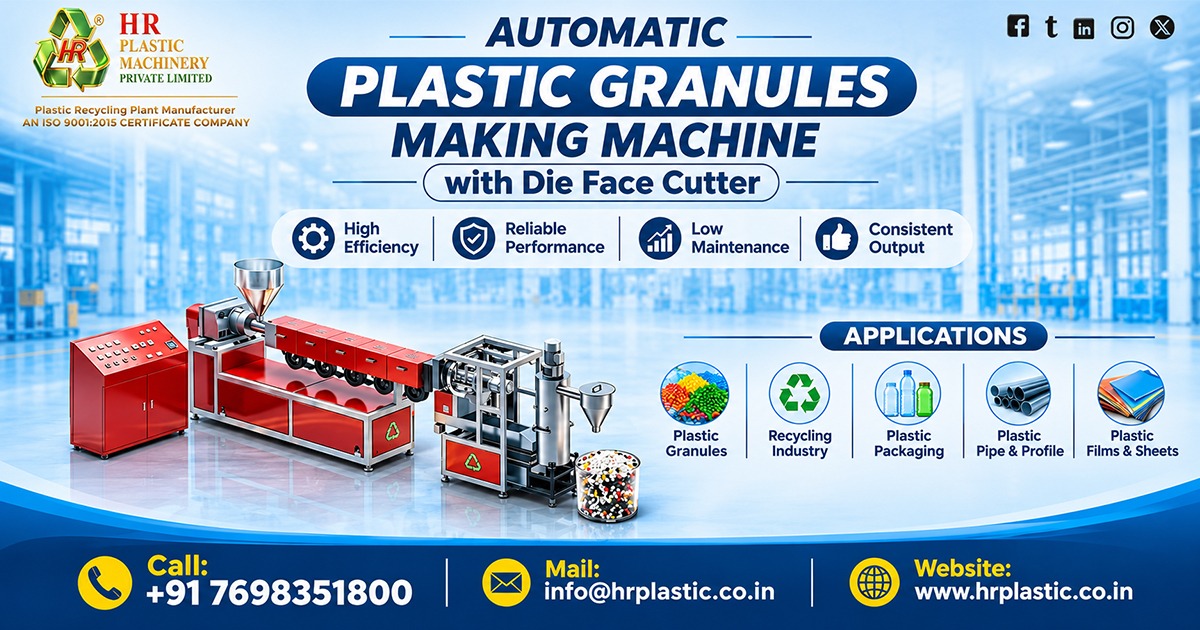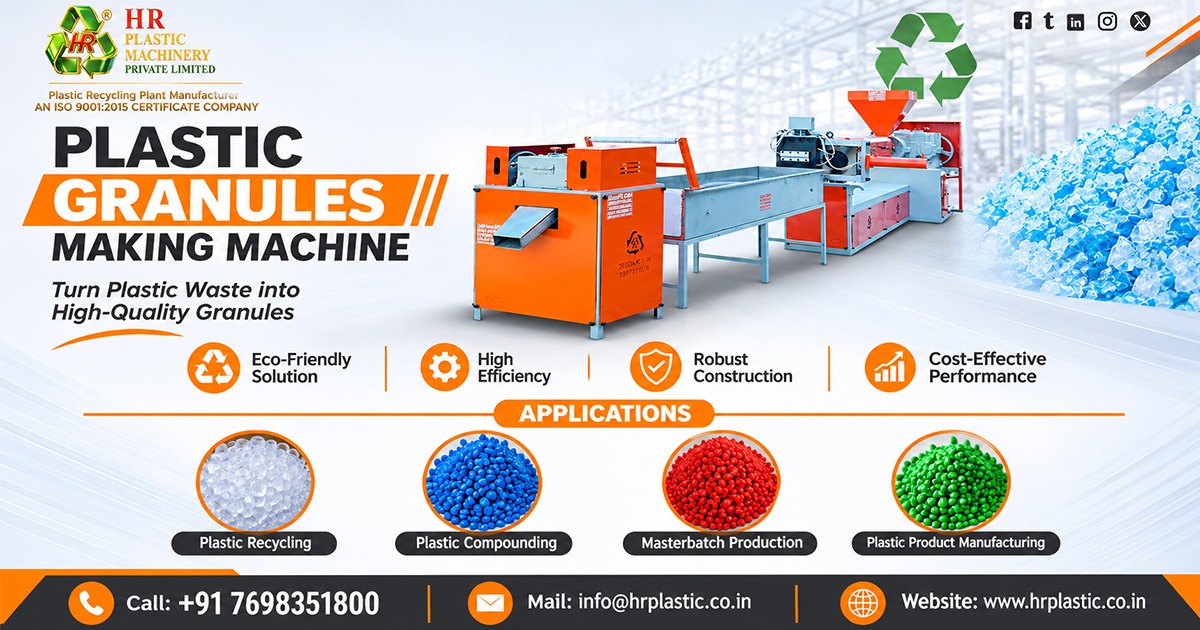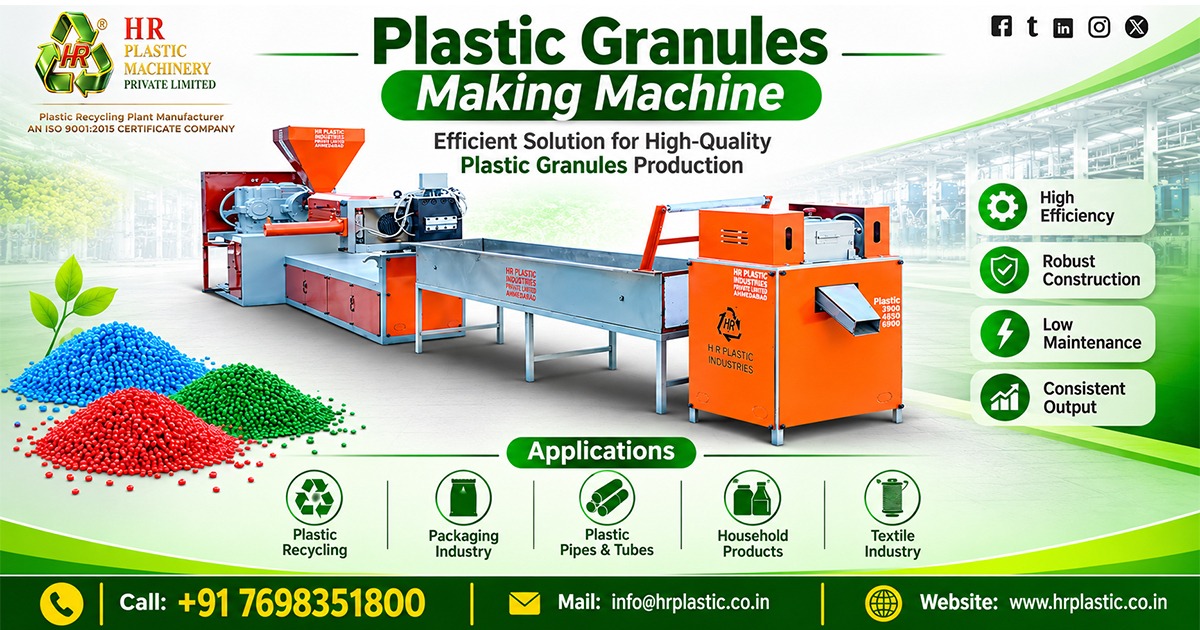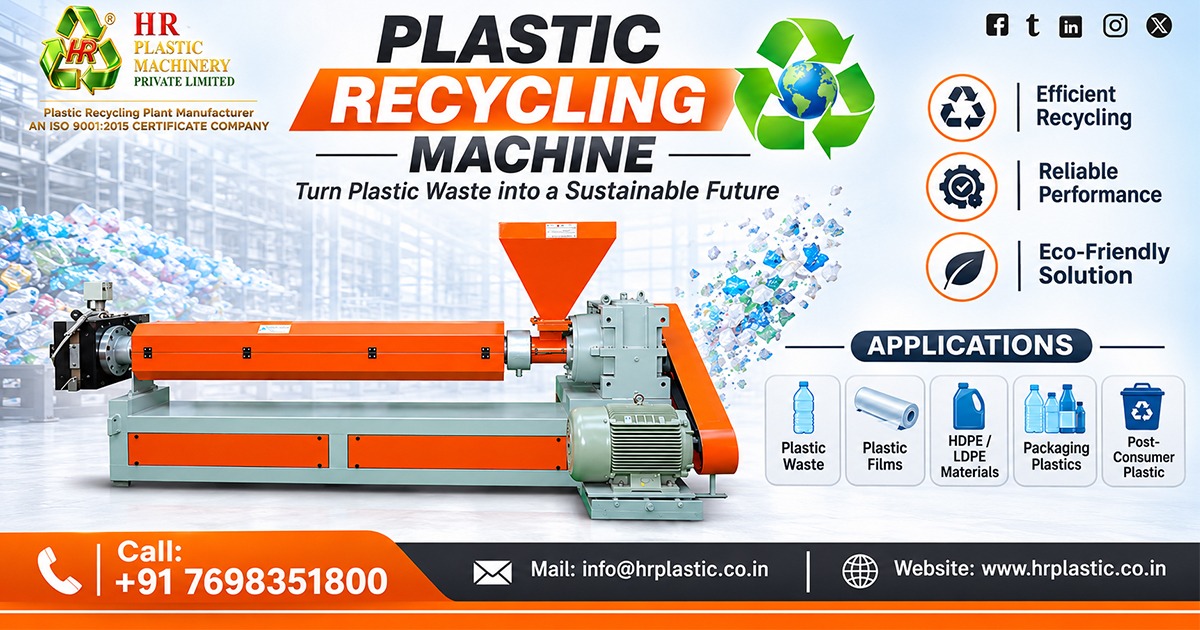
Plastic recycling plants need equipment that can process suitable plastic waste into reusable granules with consistent production flow. Selecting Plastic Granule Production Equipment for Recycling Plants requires careful planning of raw material, processing capacity, machine configuration, and output requirements. HR Plastic Machinery Private Limited provides manufacturing support from Ahmedabad, Gujarat, India.
What Should a Recycling Plant Consider Before Setting Up Granule Production?
A plastic recycling project involves more than purchasing a granule-making machine. Buyers must understand the complete production requirement, starting from the type of plastic waste available to the quality and form of the finished granules.
Important points to assess include:
- Raw material category: Identify whether the plant will process PP, PE, HDPE, LDPE, or another suitable thermoplastic material.
- Input condition: Check whether the plastic waste is clean, washed, dried, shredded, or requires additional preparation.
- Output requirement: Determine the intended granule size, material consistency, and end-use requirements.
- Production target: Estimate the quantity of material that needs to be processed during the planned operating hours.
- Available infrastructure: Consider electrical supply, installation space, material movement, and supporting equipment.
These details help buyers identify a suitable production configuration instead of selecting machinery based only on its purchase price.
How Plastic Waste Moves Through the Granule Manufacturing Process
The production process generally involves preparing plastic waste, feeding it into processing equipment, melting and forming the material, and converting it into reusable granules.
A typical recycling workflow includes the following stages:
Step 1 – Plastic Waste Preparation
Collected plastic waste is sorted according to material type. Washing and drying may be required depending on contamination and input condition.
Step 2 – Size Reduction
Plastic material is shredded or cut into smaller pieces to make feeding and subsequent processing more manageable.
Step 3 – Material Feeding
Prepared plastic pieces are supplied to the processing machine through the appropriate feeding arrangement.
Step 4 – Melting and Extrusion
The plastic is heated and processed through an extrusion system. Temperature settings and processing conditions depend on the material being handled.
Step 5 – Granule Formation
The processed plastic is converted into smaller granules through the selected cutting arrangement.
Step 6 – Collection and Storage
Finished granules are collected for cooling, inspection, packing, or further use, depending on the plant’s production arrangement.
The exact sequence and supporting equipment may vary according to the machine configuration and recycling material.
Matching Machine Capacity With the Recycling Plant’s Daily Requirement
Incorrect capacity planning can create difficulties in material feeding, production scheduling, and equipment utilisation.
When evaluating Plastic Granule Production Equipment for Recycling Plants, buyers should consider the following factors:
- Daily raw material availability: Machine selection should reflect the quantity of plastic waste consistently available to the plant.
- Material processing behaviour: Different plastic materials have different melting and processing characteristics.
- Operating hours: Calculate the expected production requirement based on actual working hours and planned operating shifts.
- Output demand: Consider whether granules will be consumed internally or supplied to other plastic manufacturers.
- Future production plans: If expansion is expected, discuss whether the proposed equipment configuration can accommodate additional requirements.
A machine should be selected according to realistic production needs rather than an assumed maximum output figure.
Technical Details That Influence Granule Production Consistency
The quality of recycled granules depends on several connected factors. Equipment selection should therefore consider the entire processing arrangement rather than focusing on one machine component.
| Technical consideration | Why it matters |
| Screw and barrel arrangement | Influences material movement and processing suitability |
| Heating system | Supports controlled melting according to material requirements |
| Motor and drive system | Must match the intended processing load |
| Feeding arrangement | Helps maintain a suitable material supply |
| Extrusion die | Influences the formation of processed plastic |
| Cutting arrangement | Determines the granule formation method |
| Control panel | Allows operators to manage machine operating settings |
Buyers should also discuss material compatibility, operating conditions, machine accessibility, and the availability of replacement components before finalising the configuration.
Installation and Maintenance Planning for Continuous Plant Operations
The installation environment has a direct influence on equipment accessibility and daily working arrangements.
Before installing the machinery, consider:
- Adequate floor space for the main machine and supporting equipment.
- Suitable foundation and equipment positioning.
- Electrical connections compatible with the machine’s requirements.
- Space for raw material storage and finished granule collection.
- Safe access for operators and maintenance personnel.
- Sufficient clearance for inspection and component replacement.
Routine maintenance considerations
- Remove accumulated plastic residue from accessible machine areas according to the manufacturer’s instructions.
- Inspect heating components, electrical connections, and control systems.
- Check moving components and drive arrangements for unusual noise or vibration.
- Monitor screw, barrel, and other material-contact components for wear.
- Follow suitable lubrication procedures wherever applicable.
- Maintain an inventory of important replacement parts.
Preventive inspection and proper operating practices can help identify developing problems before they interrupt production.
Quality Checks to Complete Before Purchasing Recycling Machinery
A purchase decision should include technical verification and supplier discussions. Buyers can use the following checklist before confirming an order.
- Confirm that the machine is suitable for the intended plastic material.
- Discuss the expected input condition and preparation requirements.
- Verify the proposed processing capacity and operating conditions.
- Review the screw, barrel, heating, extrusion, and cutting arrangements.
- Understand the machine dimensions and installation requirements.
- Ask about inspection and testing procedures before dispatch.
- Confirm the control panel arrangement and operator requirements.
- Discuss spare-part availability and replacement procedures.
- Clarify installation assistance and after-sales technical support.
A practical evaluation of these points helps reduce the possibility of selecting machinery that does not match the actual recycling process.
Services
HR Plastic Machinery Private Limited can be approached for discussions related to plastic processing and granule production machinery.
1. Plastic Granule Machine Manufacturing: Machinery manufacturing based on the discussed recycling and granule production requirements.
2. Recycling Equipment Configuration: Assistance in identifying suitable machine arrangements according to the plastic material and intended processing workflow.
3. Machine Customisation Support: Discussion of relevant machine configurations and production requirements before finalising the equipment.
4. Technical and Installation Assistance: Support for equipment-related installation planning, operating guidance, and maintenance requirements.
Industrial Plastic Recycling Opportunities Across Gujarat
Gujarat has several industrial and commercial centres where plastic processing, packaging, polymer manufacturing, and recycling activities create demand for suitable production machinery. Plastic Granule Production Equipment for Recycling Plants is relevant to businesses planning recycling operations in Ahmedabad, Vadodara, Surat, Rajkot, Gandhinagar, Bharuch, Ankleshwar, Vapi, Valsad, Morbi, Jamnagar, Bhavnagar, Mehsana, Kalol, Sanand, Changodar, Vatva, Naroda, Odhav, Halol, Dahej, Savli, Kutch, and Dholka.
Planning Your Recycling Machinery Requirement With HR Plastic Machinery Private Limited
Selecting suitable machinery becomes easier when the supplier understands the complete recycling requirement rather than just the expected production quantity.
HR Plastic Machinery Private Limited supports industrial buyers with manufacturing support from Ahmedabad, Gujarat, India. Buyers can visit hrplastic.co.in to learn more about the company’s plastic processing machinery.
Before discussing an equipment configuration, buyers should prepare information about:
- Plastic material types to be processed.
- Available raw material quantity.
- Required production output.
- Existing recycling equipment.
- Available installation space.
- Future production expansion plans.
Sharing these details helps establish a clearer basis for machinery selection and project discussions.
Frequently Asked Questions
Q1. Which plastic materials can be processed using granule production machinery?
A: Depending on the machine configuration, plastic granule production equipment can be designed for materials such as PP, PE, HDPE, and LDPE. Material compatibility should be confirmed before ordering.
Q2. Does a recycling plant need washing equipment before granule production?
A: Washing requirements depend on the condition of incoming plastic waste. Contaminated material may require washing and proper drying before entering the granule production process.
Q3. How can a buyer determine the required machine capacity?
A: Calculate the available plastic waste quantity, expected production hours, and required finished granule output. Discuss these figures with the manufacturer before selecting the machine.
Q4. What information should be shared when requesting a machinery quotation?
A: Share the plastic material type, input condition, expected processing quantity, required output, available space, and automation preferences. This helps the supplier understand the project requirements.
Conclusion
Successful recycling production depends on matching machine configuration with raw material characteristics, processing requirements, and planned output. Buyers evaluating Plastic Granule Production Equipment for Recycling Plants in Ahmedabad and across Gujarat should prioritise material compatibility, capacity planning, installation access, and maintenance support. HR Plastic Machinery Private Limited can assist with machinery-related discussions.
Planning a new plastic recycling plant or upgrading an existing production line? Contact HR Plastic Machinery Private Limited to discuss your granule production machinery requirements.
Visit: http://www.hrplastic.co.in
Email: info@hrplastic.co.in , sales@hrplastic.co.in
Call: +91 7698351800